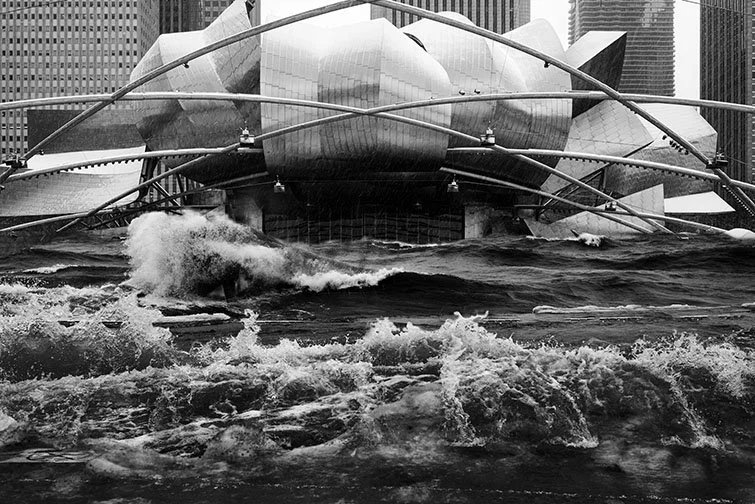
Luca Cristiano's CRT Photography series investigates the intersection of analog nostalgia and digital distortion by capturing images through cathode-ray tube screens. Challenging his own critique of screens as unfaithful mediums, Cristiano photographs CRT displays to highlight their unique glows, scans, and imperfections, turning technological artifacts into artistic commentary on media consumption. This work invites viewers to reconsider the beauty in outdated tech, emphasizing physical prints that capture the essence of mediated reality and encourage contemplative observation in an increasingly pixel-perfect world.
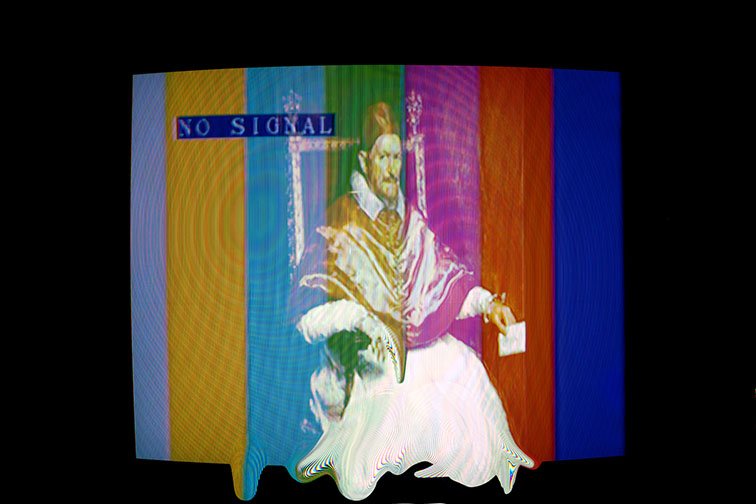
DIVINE INPUT, ’25
Limited Edition of 9 and 3AP
17” x 22” | 30” x 40”
Digital Photography | Long exposure of a cathode-ray screen’s lag time to display an image of Pope Innocent X input by a computer. Order of operations in this sleight of hand trick between the laptop screen and its input to a CRT screen: 1: wait until the connected laptop display goes to sleep (once asleep the CRT loses input and displays no signal screen), 2. Release the shutter for 5 seconds, 3. immediately wake up the laptop display by touching its trackpad half a second later, 4. The cathode-ray screen wakes up two seconds later, 5. Shutter closes and effectively captures two images during the transition from “no signal” screen to the image input from the laptop | Archival Pigment print
This photograph is a visual fallacy…
Screen’s are always passive and require a form of electrical current as a precondition to function as an active medium that can display visual/audio information.
All active screens require an input/signal carrying information in order to display an image
A screensaver only indicates that AC has been converted to DC and is not an exception because it’s image is programmed to display in absence of user input nor is an image “burnt” into a plasma or LCD display because its not the result of output but merely an indication of damage by a past input
Televisions cannot create/output information on their own, they can only display information a user inputs e.g. selecting a cable tv channel or streaming channel of a sports game
The television’s “no signal color-bar screen” always indicates that it is active but lacking an input signal e.g. the cable box is not connected.
Therefore If Pope Innocent the X appears on the Television’s “no signal screen” it must be divine input.
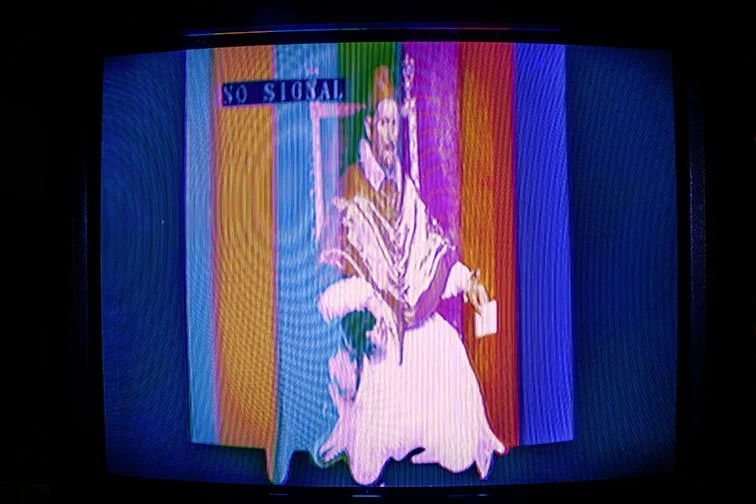
DIVINE REINPUT, 25’
Limited Edition of 9 and 3AP
Signed by the Artist
17” x 22” | “30 x 40”
Digital Photography | Long exposure of the photograph “Divine input” displayed (re-input) on the screen again: | Archival Pigment print
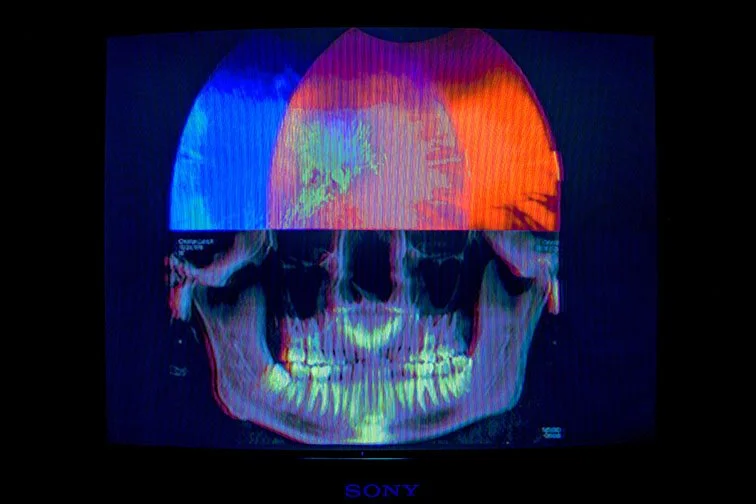
EYES AND MOUTH I. , 25’
Limited Edition of 9 and 3AP
Signed by the Artist
17” x 22” | “30 x 40”
Digital Photography/Medical imaging | A Self-portrait composed of Two Medical, i.e. “DICOM” files: 1: Optometrist’s stereoscopic digital retinal anaglyph and 2: Dentist’s digital radiograph panorama of my jaw | I married the images in post process and later displayed them together on a cathode-ray television to synthesize the information and then I set the cameras controls for long exposure photograph of the television | Archival pigment print
“This is a self portrait composed of medical imaging DICOM files. The upper portion is a photograph of my retinas with the amazing NIKON OPTOS DAYTONA. The mouth is a panoramic (digital) Radiograph of my teeth from the dentist. I combined the images in photoshop then I projected through the television and finally I took a photograph with my Nikon d850.”
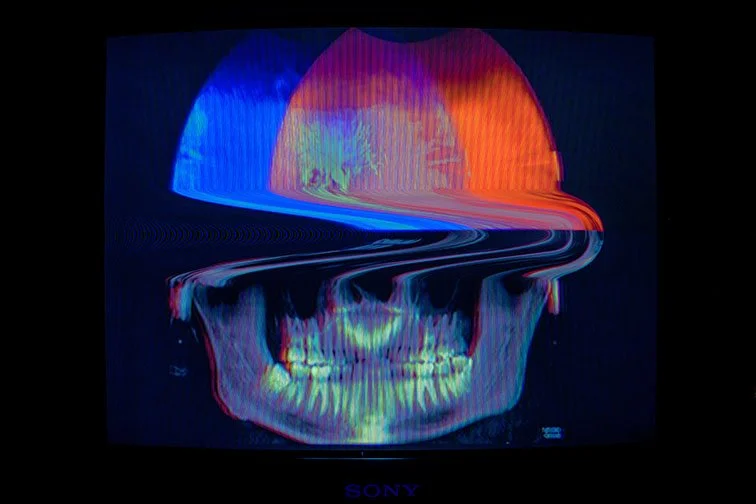
EYES AND MOUTH II. , 25’
Limited Edition of 9 and 3AP
Signed by the Artist
17” x 22” | “30 x 40”
Digital Photography/Medical imaging | A second technical Self-portrait composed of Two Medical, i.e. “DICOM” files: 1: Optometrist’s stereoscopic digital retinal anaglyph and 2: Dentist’s digital radiograph panorama of my jaw | images merged in post process and later displayed on a cathode-ray television to synthesize the information and then I took a long exposure photograph of the television | Archival pigment print
“This is a self portrait composed of medical imaging DICOM files. The upper portion is a photograph of my retinas with the amazing NIKON OPTOS DAYTONA. The mouth is a panoramic Radiograph of my teeth from the dentist. I combined the images in photoshop then I projected through the television and finally I took a photograph with my Nikon d850.”
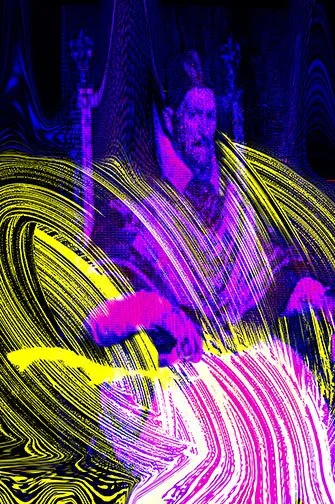
STUDY I. AFTER VELAZQUEZ’S PORTRAIT OF POPE INNOCENT X, ’25
Limited Edition of 9 and 3AP
Signed by the Artist
17” x 22” | “30 x 40”
Digital Photography | This photo is the result of complex techniques learned through much trial and error—I do not feel like writing about how I made it happen because it will confuse you. If you do decide to purchase it I’ll fly to you and buy you a coffee and breakfast to tell you every bloody detail.
“Here is a photographic study of Velásquez’s masterwork with Francis Bacon at heart…”
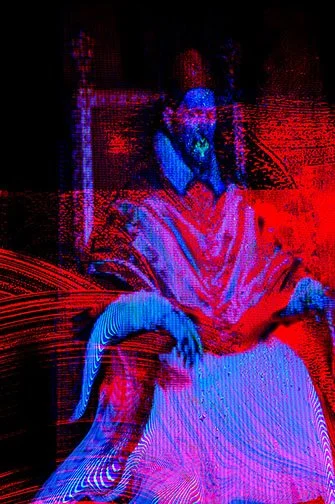
STUDY II AFTER VELAZQUEZ’S PORTRAIT OF POPE INNOCENT X, ’25
Limited Edition of 9 and 3AP
Signed by the Artist
17” x 22” | “30 x 40”
Digital Photography | This is the second photo study. It too is the result of the same techniques—here’s a cryptic description to whet your beak:
“Francis Bacon study’s of the portrait almost always show a Screaming mouth and this is a difficult thing to simulate with a camera. The green mouth you see is actually a panoramic digital radiograph (different than the one shown in “EYES AND MOUTH I & II) aka -x-ray of my own mouth I requested from the dentist. I sprayed the television’s glass with…Photoshop was only necessary to alter the colors and enhance my soap strokes…
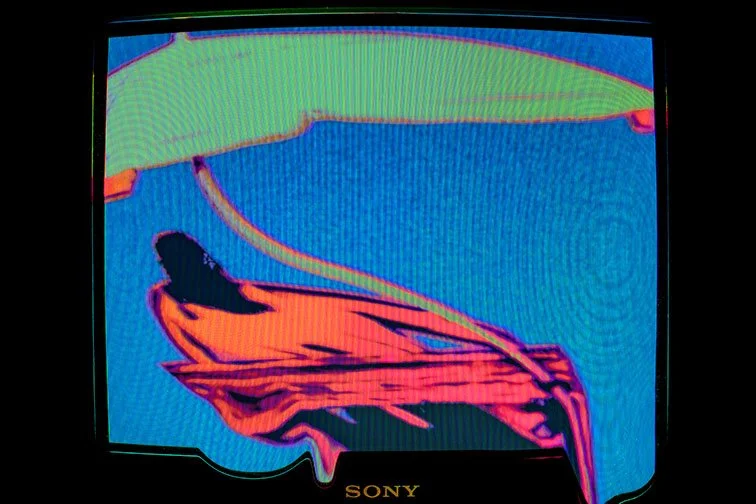
LIFE GAURD, ’25
Limited Edition of 9 and 3AP
Signed by the Artist
17” x 22” | “30 x 40”
Digital Photography | Long exposure photograph of still image of a lifeguard on a Sony Triniton Cathode-ray television | Archival Pigment print
“I took a walk to get some sun and I took snapshot of a life guard under an umbrella. It was not an informative image until I manipulated and photographed it again projecting through an old CRT TV.”
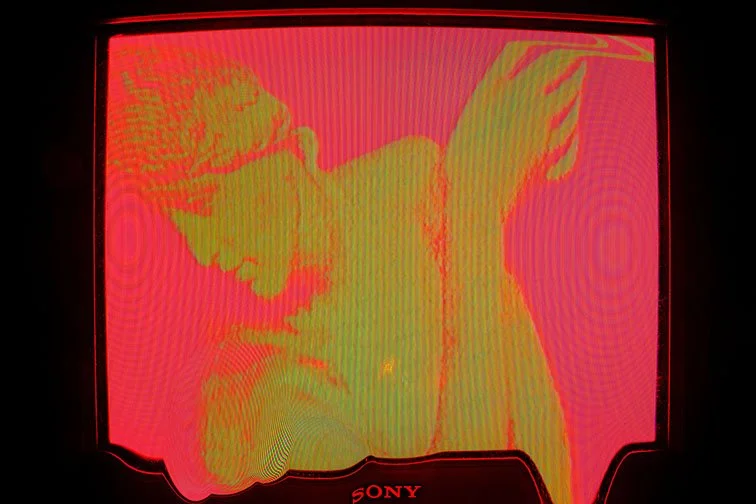
TECHNICAL IMAGE OF VENUS, ’25
Limited Edition of 9 and 3AP
Signed by the Artist
17” x 22” | “30 x 40”
Digital Photography | Long exposure photograph of a CRT television displaying a photo I took of an early 20th century albumen print of a marble statue of Venus | I did not travel to the museum in Italy to take this picture instead I scanned an old albumen photographic print… I input the bitmap scan-file into photoshop where I converted it to grayscale which allowed me to play with the color and when I was satisfied I input to the television in order to reprocess it for the sake of creating a new photographic record of the statue.Archival Pigment print
“It is a totally new image despite the fact that I lifted its information from an old Albumen print. Does this information belong to anyone, in light of the fact that the sculpture was not the work of the first photographer? The sculpture belongs to the sculptor for sure but if it were not for mythological information about Venus in texts or by oral storytelling prior to the sculptor’s knowledge he could never have thought to inform a piece of stone with an idea Venus’s form. There are no original ideas and all information is derivative, there are only new perspectives and expressions/representations of the human condition. It’s a bit strange to sit in front of television for the sake of photography. The television is no different from the iPhone screen in terms of its intended use which is to display information for the eyes to consume. Instead of using it to consume I use it to create information for others to consume in person or in a fine art gallery setting. Technical images are created by artists working alongside an apparatus, e.g. cameras, videocameras, scanners—that is why an artist with a camera is called a Cameraman or photographer. He is both functionary of the camera and the author of whatever he photographs. Great photographers are capable of making the camera work in service of their intention. All photographers must have the technical knowledge of how to operate a camera but not all photographers are artists. The majority of photographers simply know how to be a functionary of the camera and produce snapshots. Snapshots are images that are without an idea, snapshots are merely expressions of a camera brand’s complex program: technicians are flesh tripods programing the camera to preform its function. The artist working alongside a camera is, to be fair, also a functionary of his camera apparatus but the difference is that he works against the program of the camera to create an informative image. An Informative image is an attempt to communicate something new about the condition of being a human in the world. The Greatest photographs serve as the world’s memory but it does not require the photographer to show something humans have never encountered. A good photograph is like poetry, poetry expresses human feelings and experience. It is a shared experience and thus we already live poetry but it takes a poet to notice it all and put it into words. Informative photographs are always indicative of the historical spirit of the present so people in the future can look back and understand what we’re going through right now and to help them understand their now.”
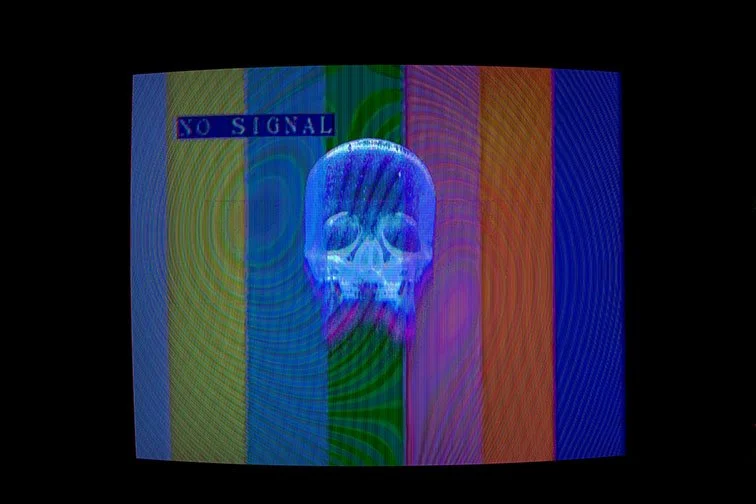
POLTERGEIST, ’25
Limited Edition of 9 and 3AP
Signed by the Artist
17” x 22” | “30 x 40”
Digital Photography | Long exposure photograph of a CRT television displaying my circuit-bent Photograph, “5g CELLULAR SERVICE” | Archival Pigment print
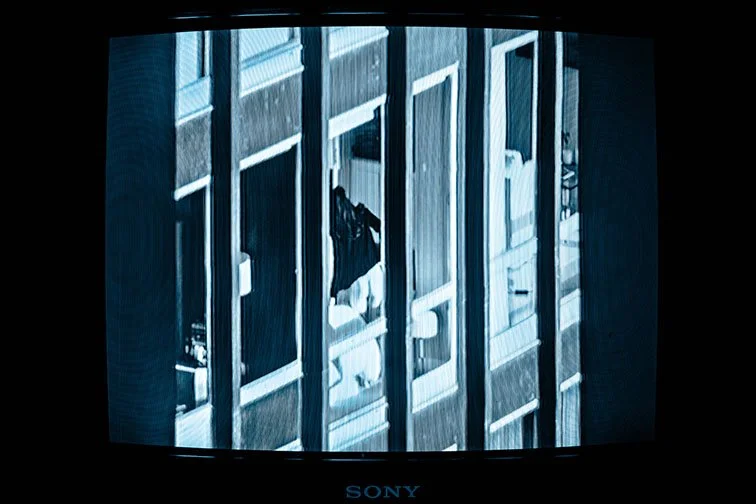
THE GIRL NEXT DOOR ON TV I. , ’25
Standard Size
Limited Edition of 9 and 3AP
Signed by the Artist
17” x 22” Unframed
16” x 20” Matted and framed
Large Size
Limited Edition of 9 and 3AP
Signed by the Artist
36” x 48” Unframed
34” x 46” Matted and framed
Digital Photography | Portrait II of Ms. A displayed and Photographed on CRT TV Screen | Print Format: Archival Pigment print
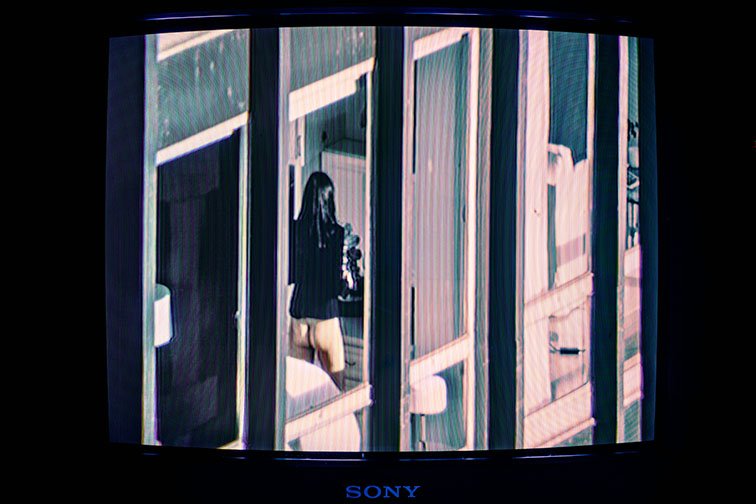
THE GIRL NEXT DOOR ON TV II. , ’25
Standard Size
Limited Edition of 9 and 3AP
Signed by the Artist
17” x 22” Unframed
16” x 20” Matted and framed
Large Size
Limited Edition of 9 and 3AP
Signed by the Artist
36” x 48” Unframed
34” x 46” Matted and framed
Digital Photography | Portrait III of Ms. A displayed and Photographed on CRT TV Screen | Print Format: Archival Pigment print